
Editor’s note: This guest feature is adapted from Chris Slater’s executive briefing, “The Silent Crisis on the Web: Why Your Website Is Losing Ground,” originally published on chrisslater.ai. Chris and his firm, All Clear Digital, are strategic partners of Falls+Partners.
In our last post, we looked at how AI search is changing the way customers find small businesses. Chris Slater has spent more than 20 years on the technical side of search, code and web systems, and his read on the current moment is blunt: a lot of business websites are quietly losing ground, and the platform underneath them is a big part of the reason.
If your organic traffic feels unpredictable, your paid acquisition costs keep creeping up or your site feels sluggish next to modern web apps, Chris argues you aren’t imagining it.
What changed in search
Chris points to three shifts from the past year and a half that have hit legacy websites hardest:
- AI Overviews. Google increasingly summarizes answers itself and cites the pages it can read quickly and understand clearly — not just the ones that match a keyword.
- Penalties for bloat. Sites carrying dozens of plugins and slow database calls tend to slide down the results.
- Sub-second expectations. Visitors expect app-like speed. In Chris’s experience, once a page takes much more than a second and a half, people start leaving before the pitch even loads.
Where legacy platforms hit a ceiling
Chris doesn’t single out one platform. WordPress, Drupal, Webflow, HubSpot CMS, Shopify, Squarespace and Wix each run into their own version of the same wall:
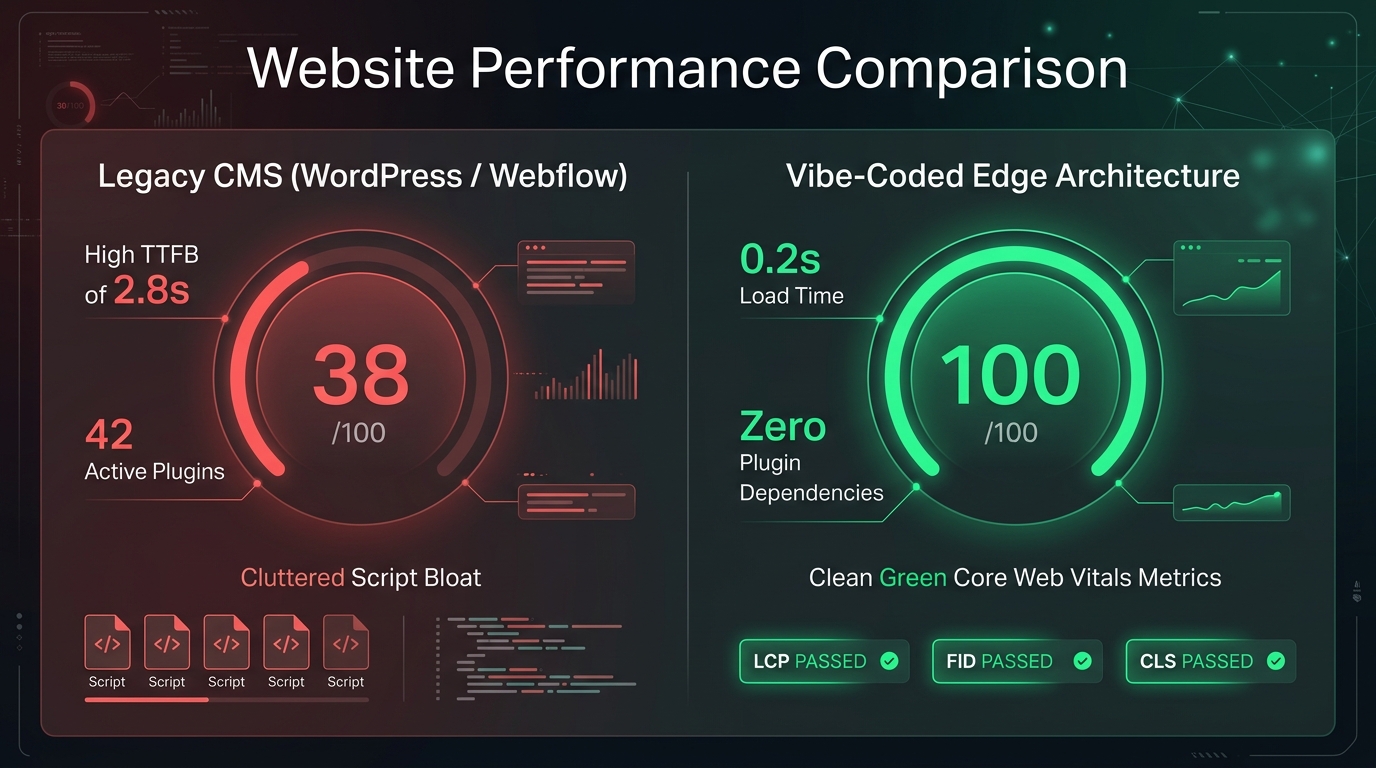
- Open-source monoliths like WordPress and Drupal often lean on 30 or more plugins, and a single update can break something in production.
- Visual page builders such as Elementor and Divi wrap content in layers of extra markup that slow phones down and make pages harder for crawlers to parse.
- Proprietary no-code tools trade convenience for lock-in: rising tier prices, limits on custom logic and exported code that’s hard to tune.
- E-commerce platforms pile up tracking pixels and app scripts that can add seconds to a mobile checkout.
Two costs follow from that. Routine updates quietly break forms, tracking or funnels, which keeps businesses paying ongoing maintenance retainers. And AI-driven search has a harder time pulling clean entity and schema information out of cluttered pages.
What “vibe coding” actually means
The term gets thrown around a lot. In Chris’s framing, people own the strategy — the architecture, the brand feel and what the page needs to convert — while AI coding agents write, test and assemble production code underneath that direction. A domain expert working with those agents can build a tailored, fast site in days instead of months.
The payoff he describes: no unused theme or plugin code, custom tools such as pricing calculators and onboarding flows that used to require enterprise budgets, delivery from global edge networks that routinely scores in the 95–100 range on Google PageSpeed, and campaign pages that ship in hours rather than waiting on an agency sprint.
You don’t have to give up WordPress
This is the part I’d point most marketing teams to. Plenty of teams love the WordPress dashboard and its publish button. Chris’s answer is a headless WordPress hybrid: writers and editors keep working in the WordPress admin they know, and hitting Publish sends a webhook that rebuilds that page on a fast front end served from the edge. Visitors and search engines never touch the WordPress database, which also takes most of WordPress’s public attack surface off the table.
What it means depending on your seat
- CEOs and founders: fewer plugin retainers (Chris estimates development costs can drop by as much as 70%) and interactive tools competitors on template builders can’t easily copy.
- CMOs and marketers: faster pages mean fewer bounces from paid traffic, and native JSON-LD structured data gives AI Overviews something clean to cite.
- CTOs and developers: a modern TypeScript and edge-rendered stack, git-backed deployments and far less plugin-conflict debt.
Our take
This lines up with what we see in agentic and AI search: the sites that get found, cited and recommended are the ones machines can load fast and understand without guessing. The benchmarks above are Chris’s, and your numbers will depend on your site, so start by measuring. Run your homepage and a key landing page through PageSpeed Insights, count your plugins and ask how many your business actually needs.
Get a read on your own site
Chris offers a complimentary AI-readiness and site audit that covers where your current site is leaking traffic, a speed and script audit of plugin bloat and Core Web Vitals bottlenecks, and a prototype of what your site could look like rebuilt on a modern stack. Contact Chris through All Clear Digital, or reach out to Falls+Partners and we’ll talk through it together.
Read Chris Slater’s full briefing, “The Silent Crisis on the Web,” on chrisslater.ai.